



Event Chain Methodology Overview
Event Chain Methodology – New Way of Project Scheduling
Intaver’s Event Chain Methodology is a new project scheduling technique. Event chain methodology is the next advance beyond Critical Path Method (CPM) and Critical Chain Project Management (CCPM). Event Chain Methodology is an extension of traditional Monte Carlo Simulations and project risk analysis with Risk Driver.
Click here to lean more about limitations of ‘traditional’ Monte Carlo
Event chain methodology is an uncertainty modeling and schedule network analysis technique that is focused on identifying and managing events and event chains that affect project schedules. Event chain methodology helps to mitigate the negative impact of psychological heuristics and biases, as well as to allow for easy modeling of uncertainties in the project schedules.
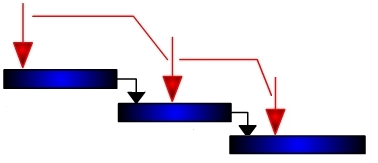
Event Chain Methodology Objectives:
- Mitigate effect motivational and cognitive biases in estimating and scheduling. In many cases, project managers intentionally or unintentionally create project schedules that are impossible to implement.
- Simplify the process of defining risks and uncertainties in project schedules, particularly improve the ability to provide reality checks and visualize multiple events.
- Perform more accurate quantitative analysis while taking to an account such factors as relationship between different events and actual moment of the events.
Event Chain Methodology Principles:
Moment of risk and state of activity
Event Chains
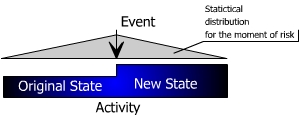
An activity (task) in most real life processes is not a continuous uniform procedure. Tasks are affected by external events, which transform an activity from one state to another.
One of the important properties of an event is the moment when an event occurs during the course of an activity. This moment, when an event occurs, in most cases is probabilistic and can be defined using statistical distribution.
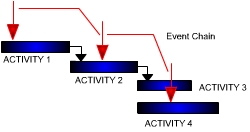
Events can cause other events, which will create event chains. These event chains can significantly affect the course of the project.
For example, requirement changes can cause an activity to be delayed. To accelerate the activity, the project manager allocates a resource is from another activity, which then leads to a missed deadline. Eventually, this can lead to the failure of the project.
Monte Carlo Simulations
Critical Event Chains
Once events and event chains are defined, quantitative analysis using Monte Carlo simulation can be performed to quantify the cumulative impact of the events. Probabilities and impacts of risks are using as in input data for Monte Carlo simulation of the project schedule. In most real life projects, it is necessary to supplement the information regarding the uncertainties expressed as an event with distributions related to duration, start time, cost, and other parameters.
The single events or the event chains that have the most potential to affect the projects are the “critical events” or “critical chains of events.” By identifying critical events or critical chains of events, we can mitigate their negative effects. These critical chains of events can be identified by analyzing the correlations between main the project parameters, such as project duration or cost, and the event chains.
History Matching and Relevance Analysis
Critical Event Chains
In many projects, it is hard to determine which historical data should be used as an analog for future analysis. To improve the accuracy of estimates based on risk occurrence data, the selection of analogs for the historical data should be done through an analysis using a Bayesian approach. The selection of an event with its respective probabilities and impact from the historical data is based on an analysis of evidence regarding how relevant the event is to the current activity or project. If an event is a full or partial match according to the selected criteria, it will contribute to the overall evidence that this event is relevant to the current activity.
Monitoring the activity’s progress ensures that updated information is used to perform the analysis. During the course of the project, the probability and time of the events can be recalculated based on actual data. The main issue with performance tracking is forecasting an activity’s duration and cost if an activity is partially completed and certain events are assigned to the activity. The simple heuristic approach to this problem is to analyze the moment of risk, which is defined as one of the event parameters. Advanced analysis can be performed using a Bayesian approach.
Event Chain Diagrams
Repeated Activities
Event Chain Diagrams are visualizations that show the relationships between events and tasks and how the events affect each other. The simplest way to represent these chains is to depict them as arrows associated with certain tasks or time intervals on the Gantt chart. Different events and event chains can be displayed using different colors. Events can be global (for all tasks in the project) and local (for a particular task). By using Event Chain Diagrams to visualize events and event chains, the modeling and analysis of risks and uncertainties can be significantly simplified.
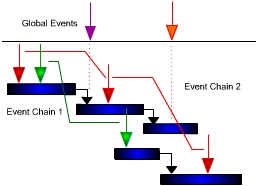
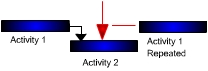
Sometimes events can cause the start of an activity that has already been completed. This is a very common scenario for real life projects; sometimes a previous activity must be repeated based on the results of a succeeding activity Modeling of these scenarios using event chain methodology is simple. The original project schedule does not need to be updated, as all that is required is to define the event and assign it to an activity that points to the previous activity. In addition, a limit to the number of times an activity can be repeated needs to be defined.
Event Chains and Risk Mitigation
Resource Allocation Based on Events
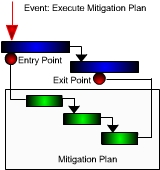
If event or event chain occurs during the course of a project, it may require some mitigation effort. In some cases, mitigation plans can be generated. Mitigation plans are an activity or group of activities (small schedule) that augment the project schedule if a certain event occurs. The solution is to assign the mitigation plan to an event or event chain. These small schedules will be triggered when an event chain occurs. The same mitigation plan can be used for different events. Each mitigation plan will have entry and exit points.
One potential event is the reassignment of a resource from one activity to another, which can occur under certain conditions. For example, if an activity requires more resources to complete it within a fixed period, this will trigger an event to reallocate the resource from another activity. Reallocation of resources can also occur when activity duration reaches a certain deadline or the cost exceeds a certain value. Events can be used to model different situations with resources, e.g. temporary leave, illness, vacations, etc.